
3 Types of Driving Distractions to Stay Away From
Legally Reviewed by Phil Younglove, Esq. on July 30, 2026
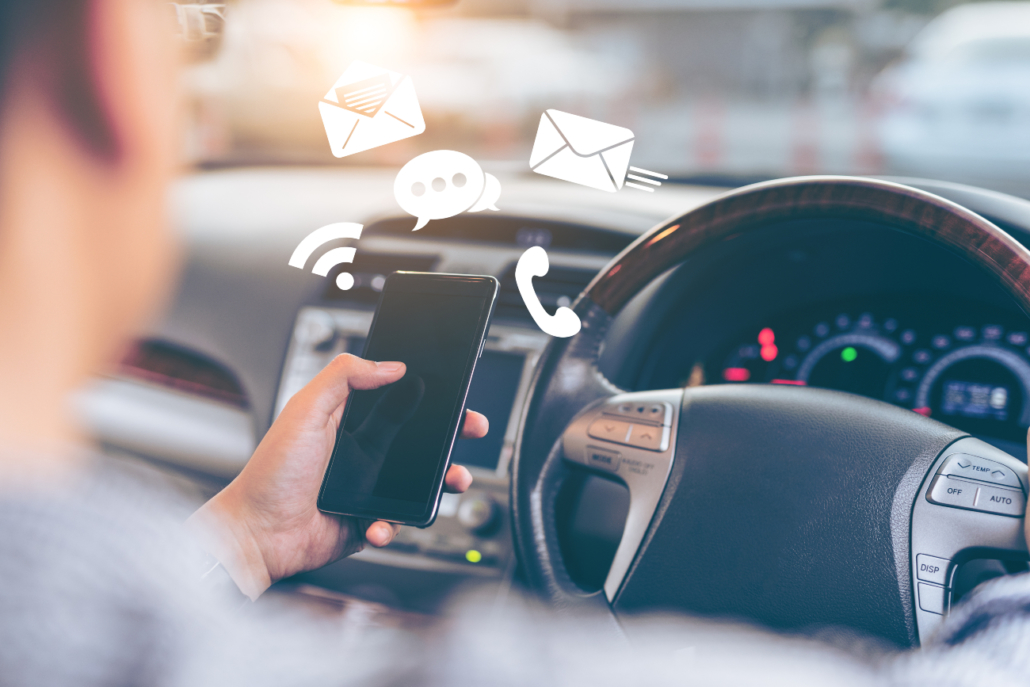
Distracted driving happens whenever something pulls a driver’s attention, hands, or eyes away from the road, and safety researchers generally group these distractions into three core categories: visual, manual, and cognitive. Some organizations also track a fourth category, auditory distraction, since sounds inside or outside the vehicle can pull focus away from driving just as easily as a glance at a phone. Recognizing which category a distraction falls into can help drivers understand why certain habits, like eating behind the wheel or adjusting a navigation app, are more dangerous than they seem.
At Younglove Law Group, we regularly help clients throughout California who were hurt by a driver who was texting, eating, adjusting a stereo, or simply not paying attention. Our attorneys who handle distracted driving accident claims see firsthand how these small lapses in attention lead to serious, life-altering collisions, and we believe drivers deserve to understand exactly what they are up against on the road. This guide walks through the recognized categories of distraction, what current data and California law say about the problem, and what steps tend to matter most for someone who has already been hurt.
Understanding Distracted Driving
Distracted driving is a significant concern on California roads, posing a threat to the safety of drivers, passengers, cyclists, and pedestrians alike. Any activity that diverts a person’s attention away from the primary task of driving, whether that is texting, eating, or even daydreaming, qualifies as a distraction. This can include visual, manual, cognitive, and auditory distractions, and many dangerous moments behind the wheel actually involve more than one type at once, such as a driver who glances at a text message while also thinking about how to respond.
Understanding these categories is crucial for preventing accidents and ensuring road safety. By recognizing the various forms of driver distraction, drivers can take proactive steps to minimize risk and protect themselves and everyone else sharing the road.
Distraction is also a factor that insurance companies and courts take seriously when determining fault after a crash. A driver who was looking at a phone, reaching for a drink, or lost in thought instead of watching the road can be found negligent in the same way a speeding or drunk driver would be. Establishing that link between distraction and negligence in a personal injury case is often where a claim actually begins.
What Are the Types of Distracted Driving?
While many people first think of texting when dangerous distractions come up, there are many different ways a driver’s focus can be diverted. Nearly every distraction fits into one of the following categories.
Visual
Visual distractions, such as billboards, a phone screen, or objects outside the car, divert a driver’s attention from the road onto something else, effectively taking their eyes off the road. While some outside distractions are unavoidable, limiting the ones inside the vehicle, like propped-up phones or cluttered dashboards, can help prevent accidents. Many crashes occur simply because a driver looked away for a moment longer than intended, and even a glance of a few seconds can mean traveling a significant distance without watching the road ahead.
Manual
When a distraction causes a driver to take one or both hands off the steering wheel, it is classified as a manual distraction. Common examples include texting, changing the radio station, eating, or reaching for an item in the back seat. Keeping both hands on the wheel at all times can be challenging, but unexpected situations occur constantly on the road, and reduced control can turn a minor hazard into a severe accident. Drivers of larger vehicles, including delivery vans and commercial trucks, face heightened risk here since a manual distraction leaves less margin to correct course.
Cognitive
Cognitive distractions occur when a driver’s mind wanders away from the task of driving, even if their eyes stay on the road and their hands stay on the wheel. Stress, a difficult conversation, or a strong emotion can all cause a driver’s mind to drift. If you have ever arrived somewhere with little memory of the drive itself, you have likely experienced this kind of “mind-wandering,” which often happens during repetitive tasks or familiar routes. Voice-activated systems and hands-free calls reduce manual and visual distraction, but they do not eliminate the cognitive load of holding a conversation while driving.
Auditory
Some safety organizations also recognize a fourth category: auditory distraction. Loud music, a phone notification, or an animated conversation with passengers can all interfere with a driver’s ability to hear traffic sounds, sirens, or horns. Auditory distractions often overlap with cognitive ones, since a driver who is straining to hear or focused on a conversation is also less mentally present for what is happening on the road. Parents driving with young children in the back seat often describe this overlap firsthand, since a crying child can pull at both a driver’s ears and their mind at once.
What the Data Shows About Distracted Driving Risk
According to the Centers for Disease Control and Prevention, crashes involving a distracted driver killed more than 3,100 people nationwide and injured about 424,000 others, with roughly one in five of those killed being pedestrians, cyclists, or others outside a vehicle rather than occupants. The CDC also notes that young adult and teen drivers are involved in distraction-related fatal crashes at higher rates than older, more experienced drivers, which is why many driver education programs now place heavy emphasis on phone-free driving habits.
These figures reflect only the crashes where distraction could be confirmed and reported, meaning the true scope of the problem is likely larger, since many drivers understandably do not volunteer that they were on their phone or otherwise distracted at the time of a collision. For anyone hurt in a crash, this data underscores how common and how preventable distraction-related collisions can be, and it is part of why phone records and other objective evidence carry so much weight in these claims.
California Laws on Distracted Driving
California has taken a firm stance against handheld phone use behind the wheel. Under the California Vehicle Code, drivers may not hold and operate a wireless telephone or electronic communications device while driving unless the device is mounted and can be activated with a single tap or swipe, or is used in a fully hands-free, voice-operated manner. The restriction applies broadly, covering everything from texting to scrolling through an app at a red light. A first violation generally carries a base fine of $20, rising to $50 for each subsequent offense, though court fees and penalty assessments often push the actual amount owed well beyond those base figures.
Despite these rules, distracted driving remains difficult to enforce, since officers cannot always observe every form of distraction in the moment a crash occurs. A driver eating a sandwich, arguing with a passenger, or lost in thought is unlikely to draw the same attention as someone visibly holding a phone, even though each can be just as dangerous. That enforcement gap is part of why our overview of California’s distracted driving laws exists as a resource, walking through how these rules apply and what they mean if you were hurt by a driver who broke them.
Most Common Injuries Sustained in Distracted Driving Accidents
Accidents can happen without a moment’s notice and change a person’s life forever. When dealing with the aftermath of a distracted driving accident, understanding the range of injuries involved can help victims recognize the seriousness of their situation. Distracted driving is more than just a lapse in judgment, and it can lead to severe harm or even death. Some of the most common injuries victims face include the following.
- Traumatic brain injuries (TBIs): caused by sudden impacts or jolts to the head
- Broken bones: common in higher-speed collisions
- Burns: resulting from airbag deployment or vehicle fires
- Spinal cord injuries: which can cause lasting mobility issues
- Whiplash: among the most frequently reported soft tissue injuries
- Concussions: often underdiagnosed immediately after a crash
- Sprains and strains: affecting joints and connective tissue
When someone is harmed in an accident caused by another driver’s negligence, they may be eligible to recover compensation for the damages they incurred. This can include not only current medical expenses, but also anticipated future treatment, lost wages during recovery, and other costs tied directly to the crash. More serious injuries, such as traumatic brain injuries or spinal cord damage, often require ongoing care long after the initial hospital visit, which can make accurately valuing a claim more complicated.
How Attorneys Prove Distracted Driving in a Claim
One of the biggest challenges in a distracted driving case is proving that the other driver was actually distracted at the moment of the crash. Distraction rarely leaves obvious physical evidence the way speeding or drunk driving might, so attorneys often rely on a combination of records and outside analysis to reconstruct what happened.
Phone carrier data is frequently central to these claims. Our attorneys often review cell phone records to determine whether a driver was on a call, sending a text, or using an app in the moments before impact. Combined with vehicle event data recorders, dashcam footage, and witness statements, this information can help establish how lawyers prove texting while driving was a factor in a specific collision.
Traffic camera footage, nearby business surveillance video, and statements from the responding officer can also help corroborate a distraction claim, particularly when a driver denies any wrongdoing after the crash. In more complex cases, an accident reconstruction professional may review skid marks, vehicle damage, and speed data to help explain how and why the collision occurred the way it did.
Because every case is different, the type of proof available can vary widely. Our overview of the evidence needed to support a distracted driving claim goes into more detail on what documentation tends to matter most and how it gets gathered after a crash.
Steps to Take After a Distracted Driving Accident
What a driver does in the hours and days after a distraction-related collision can significantly affect their ability to recover compensation later. Seeking medical attention promptly is important, even for injuries that seem minor at first, since some conditions like whiplash or concussions can take time to fully present. Documenting the scene with photos, gathering contact information from any witnesses, and requesting a copy of the police report can all help preserve evidence before it disappears or becomes harder to obtain.
Where possible, noting the other driver’s behavior immediately before the crash, such as whether they appeared to be looking at a phone or reacting late to traffic, can also be useful later. Cell phone carrier records and vehicle data are only preserved for a limited window of time, so the sooner these details are documented and an attorney is involved, the more likely that evidence is to still be available.
It is also worth being cautious with insurance adjusters in the immediate aftermath, since early statements are sometimes used later to dispute fault or minimize a claim’s value. Because California follows a pure comparative fault rule, even a driver who was partially at fault can still recover a portion of their damages, but that determination often depends on the strength of the evidence collected early on. Speaking with a car accident attorney as soon as possible after a distracted driving crash can help protect that evidence and clarify what options are realistically available.
Filing a Distracted Driving Claim in California
Most distracted driving claims begin with an insurance process rather than a lawsuit. After a crash, the parties involved typically exchange information, file a police report, and notify their respective insurance carriers. From there, an adjuster reviews the available evidence, including any records suggesting the other driver was distracted, to evaluate liability and estimate damages. Many claims resolve at this stage, though some require further negotiation or, eventually, a lawsuit if the parties cannot agree on a fair outcome.
Throughout this process, an attorney can help gather supporting documentation, communicate with insurance adjusters, and, if needed, prepare the case for litigation. Having legal representation early on can also help ensure that important deadlines, like the filing window described below, are not missed while a claim is still being negotiated.
California law also imposes a filing deadline on personal injury lawsuits. Under California Code of Civil Procedure Section 335.1, most personal injury claims must generally be filed within two years of the date of the crash, though certain circumstances, such as claims against a government entity or cases involving a minor, can shorten or extend that window. Missing the applicable deadline can prevent a court from hearing a case at all, regardless of how strong the underlying evidence may be, which is part of why early evidence preservation matters so much in distraction cases.
Frequently Asked Questions About Distracted Driving
What are the main types of distracted driving?
Safety researchers generally group distracted driving into three main categories: visual, which takes a driver’s eyes off the road, manual, which takes a driver’s hands off the wheel, and cognitive, which takes a driver’s mind off the task of driving. Some organizations also recognize a fourth category, auditory distraction, for sounds that pull attention away from traffic. Many real-world distractions, like texting, actually involve more than one category at the same time.
Is using a hands-free device considered distracted driving under California law?
California law generally permits voice-operated, hands-free use of a wireless device while driving, along with limited single-tap or single-swipe activation when the device is properly mounted. However, hands-free use can still create cognitive distraction, since a driver’s mind may be occupied by a conversation even when both hands remain on the wheel. Being legally allowed to use a device does not mean it is free of risk.
Can I recover compensation if I was partly distracted at the time of my accident?
California follows a pure comparative fault rule, which means a driver who was partially at fault for a crash may still be able to recover a portion of their damages. Compensation is typically reduced in proportion to that driver’s share of fault, rather than barred entirely. Because fault percentages can significantly affect a claim’s value, it is worth having an attorney review the specific facts of your case.
How do attorneys prove a driver was distracted before a crash?
Attorneys typically piece together evidence from several sources, including cell phone carrier records, vehicle event data recorders, dashcam or nearby security footage, witness statements, and the police report. Because distraction rarely leaves obvious physical evidence on its own, building a strong case often depends on gathering this documentation quickly, before records are deleted or footage is overwritten. In more contested cases, an accident reconstruction professional may also be brought in to help explain how the crash occurred.
Does hiring a car accident attorney cost anything upfront?
Many personal injury attorneys, including our firm, handle distracted driving cases on a contingency fee basis. This generally means there is no upfront cost to hire an attorney, and fees are only collected if compensation is recovered on the client’s behalf. This arrangement allows injured drivers to pursue a claim without added financial pressure while they are already dealing with medical bills, vehicle repairs, and lost income from missed work.
Contact Younglove Law Group for a Trusted Car Accident Lawyer
Many people do not realize how serious distracted driving is until they are personally affected by it. At Younglove Law Group, our attorneys have spent years working with clients across California who were hurt by drivers who were texting, eating, adjusting a stereo, or otherwise not paying attention to the road. We approach every case by digging into the available evidence, from phone records to crash data, to build the strongest possible picture of what happened, and we work to make sure our clients understand each step of that process along the way.
If you or someone you know was injured by a distracted driver, understanding your options matters, and you do not have to sort through them alone. Our team can review the circumstances of your crash, help identify what evidence may support your claim, and walk you through what to expect next. Fill out our contact form today to share the details of your situation and find out what steps may make sense for your case.
About the Attorney
Partner, Younglove Law Group
Phil Younglove is a partner at Younglove Law Group, a California personal injury firm he founded after working as a senior attorney at one of the state’s larger injury firms. A graduate of UCLA and USC Law, Phil focuses his practice on representing people hurt in car, motorcycle, and other vehicle collisions throughout California.


